Here's our 7 cents. Soft Skills outperform AI in ROI.
93 cents on the tech, 7 cents on your people: why most AI investments return nothing
W’ve got a question for you. Of each dollar in your AI budget, how much is going to training your team?
If your organisation is like most, the answer is about 7 cents. Deloitte's analysis of AI spending found that organisations put 93 cents of every AI dollar into data, technology and infrastructure. Just 7 cents goes to the humans: training, redesigning work, managing change, rethinking roles.
That 7 cents is what—more than any model or platform decision—predicts whether your AI investment pays off.
The numbers AI salesperson left out of their pitch deck
We’ve spent 30+ years inside corporate transformation, and we’ve never seen a gap like this one.
MIT's State of AI in Business research found that 95% of generative AI pilots produced zero measurable return. Yes, you read that right. Zero.
McKinsey reached the same conclusion through a different route. Their latest global survey found 61% of companies can't point to any profit impact from AI, and only 6% have turned it into significant profit (‘significant’ defined as AI driving 5% or more of EBIT earnings).
Two independent research teams with two different methods, reaching the same conclusion on the ROI of your AI investment. So what is the problem? We can see the value in the tech (we’re sold as such) - but if the technology isn’t the issue, what is it that’s impeding your lack of ROI? It’s what makes us human. Our ‘soft’ skills are the differentiator and the amplifier.
The gold standard study here is a randomised controlled trial published in the Journal of Political Economy. Workers were trained in human skills: communication, time management, problem solving. The result? A 13.5% lift in productivity and a 256% net return to the business within eight months. Even better, the benefits created a ripple effect. Untrained colleagues working alongside trained workers became more productive too, because stronger teamwork helped everyone thrive. The Australian data evidences the same outcomes: Deloitte Access Economics found every $1 invested in learning and development per employee is associated with an extra $4.70 in business revenue per employee. Their Premium Skills research with DeakinCo found that upskilling in human skill attainment is associated with an extra $3,822 a year in wages for the average Australian full-time worker. And by 2030, two thirds of all Australian jobs will be human skill intensive.
So let’s put the two investment opportunities side by side:
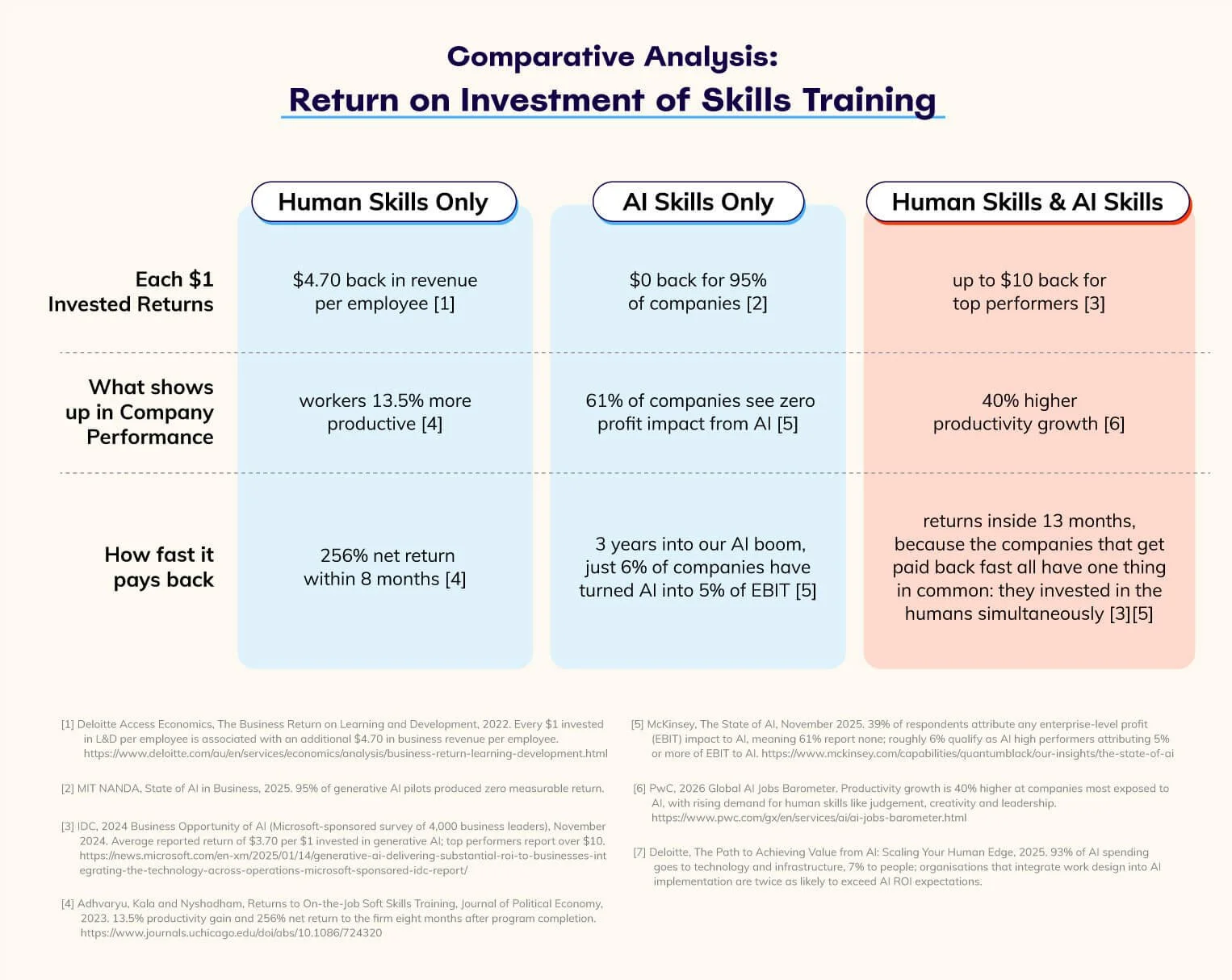
Even Microsoft's own commissioned research says the biggest barrier isn't the technology - it's whether your people have the skills.
These figures come from different studies with different methods, so treat them as directional rather than a perfect like-for-like. But the direction is unmistakable. One of these investments has a peer-reviewed track record of paying for itself fast. The other pays off for a small minority, and that minority is defined by how seriously they took the first one.
So what do the 6% do differently?
The winning pattern is consistent across the research and entirely within your control:
1. They fix the budget split
Organisations that build the human side into their AI strategy from day one are twice as likely to exceed their ROI expectations. In Deloitte's survey of 100 executives, only 9% of people-first companies fell short of their AI expectations, compared to 46% of tech-first companies.
Try this: Calculate your organisation's current tech skills-to-people skills ratio in your training budget. If it looks anything like 93 to 7, you've found your first conversation for the next leadership meeting.
2. They build the skills that direct the technology
PwC's 2026 Global AI Jobs Barometer, found AI is rapidly raising the premium on judgement, creativity, and leadership. Companies most exposed to AI are recording 40% higher productivity growth. Crucially, AI-exposed entry-level roles are now 7x more likely to demand traditionally senior skills like leadership. As machines handle routine admin, what's left is uniquely human work: ethical decision-making, critical thinking, persuading, connecting, and adapting.
Try this: Map your team's human skill strengths and gaps (here’s a handy tool) before your next AI rollout.
3. They invest in people before the rollout, not after it falls short of expectations
Pilots rarely fail because the models are bad. They fail because nothing changed around them: not the work, not the roles, and not the capability of the people expected to use them. In IDC's research for Microsoft, 52% of leaders named a lack of skilled workers as their single biggest barrier to implementing and scaling AI. The people selling the technology are telling you the bottleneck is human.
Try this: Make human skills development a line item in the AI business case itself, rather than a separate request competing against it.
Success is human. The data agrees.
We've believed this from day one, and we wrote a whole book about it. But you don't have to take our word for it. The big names of MIT, McKinsey, Deloitte, PwC and a randomised controlled trial have all arrived at the same place: AI amplifies capable humans, and does very little for anyone else.
So before the next AI budget gets signed off on, ask the 7 cent question. Your answer will tell you which side of the 95% you're heading for.
Ready to get your people AI-ready? Explore our human skill development programs for organisations, download the Hodie app to start today, or contact us at any time.
Sources
MIT NANDA, State of AI in Business, 2025 | McKinsey, The State of AI, November 2025 | Deloitte, The Path to Achieving Value from AI: Scaling Your Human Edge, 2025 | Deloitte Access Economics, The Business Return on Learning and Development, 2022 | Deloitte Access Economics and DeakinCo, Premium Skills, 2019 ($3,822 based on 2018 average earnings) | Adhvaryu, Kala and Nyshadham, Returns to On-the-Job Soft Skills Training, Journal of Political Economy, 2023 | PwC, 2026 Global AI Jobs Barometer | IDC, The Business Opportunity of AI (Microsoft-sponsored), 2023 and 2024 editions
More human goodness you might like: