If someone asks you, “Hey, what has been the greatest advantage of humans”? What would you say? For many, the answer would probably be intelligence, our ability to think, reason, solve problems and navigate difficult situations. Or perhaps, our ability to adapt, learn, and act when faced with the unexpected.
Sounds about right, doesn’t it?
Humans have come a long way. We have learnt how to build bridges, read the stars, go to the moon and take pictures, invent medicines and vaccinations (you remember how vaccinations were quickly made available when COVID struck?), navigate oceans, and so much more. The ability to think, learn, adapt and figure things out has always been our strongest suit.
And then we built something that can think with us—artificial intelligence. Humans were sharp enough to call this form of intelligence “Artificial” because they knew the intelligence that is calibrated in machines will always be far less superior to what a human brain is capable of, you know, the ‘real’ one.
AI can certainly generate ideas in seconds, make recommendations and is becoming remarkably good at some of the things we once considered uniquely intelligent. But this raises an interesting question: if machines are getting better at intelligence, what becomes more valuable about being human?
Perhaps the answer can be found in places where intelligence alone isn't enough.
For example, have you ever seen AI successfully handling pressure during meetings? Or helping a colleague who is going through a personal crisis and is juggling deadlines? Or assisting a teacher who can recognise when a student is struggling, adapt a lesson to meet their needs, or respond with empathy when a child is having a difficult day?
The problem with real life? It doesn't come with a prompt.
AI performs phenomenally well when it’s configured with a well-defined problem, data, a goal and enough context. It then becomes highly capable of finding patterns that humans perhaps take hours, days or sometimes years to uncover.
But what happens once we get the output? What happens when the data is incomplete, when two situations are equally plausible, or when the most technically efficient choice isn't necessarily the most responsible one?
In this scenario, who is asking the uncomfortable question? Who is challenging the AI’s output and actually thinking if it makes sense? This is where human judgment comes in.
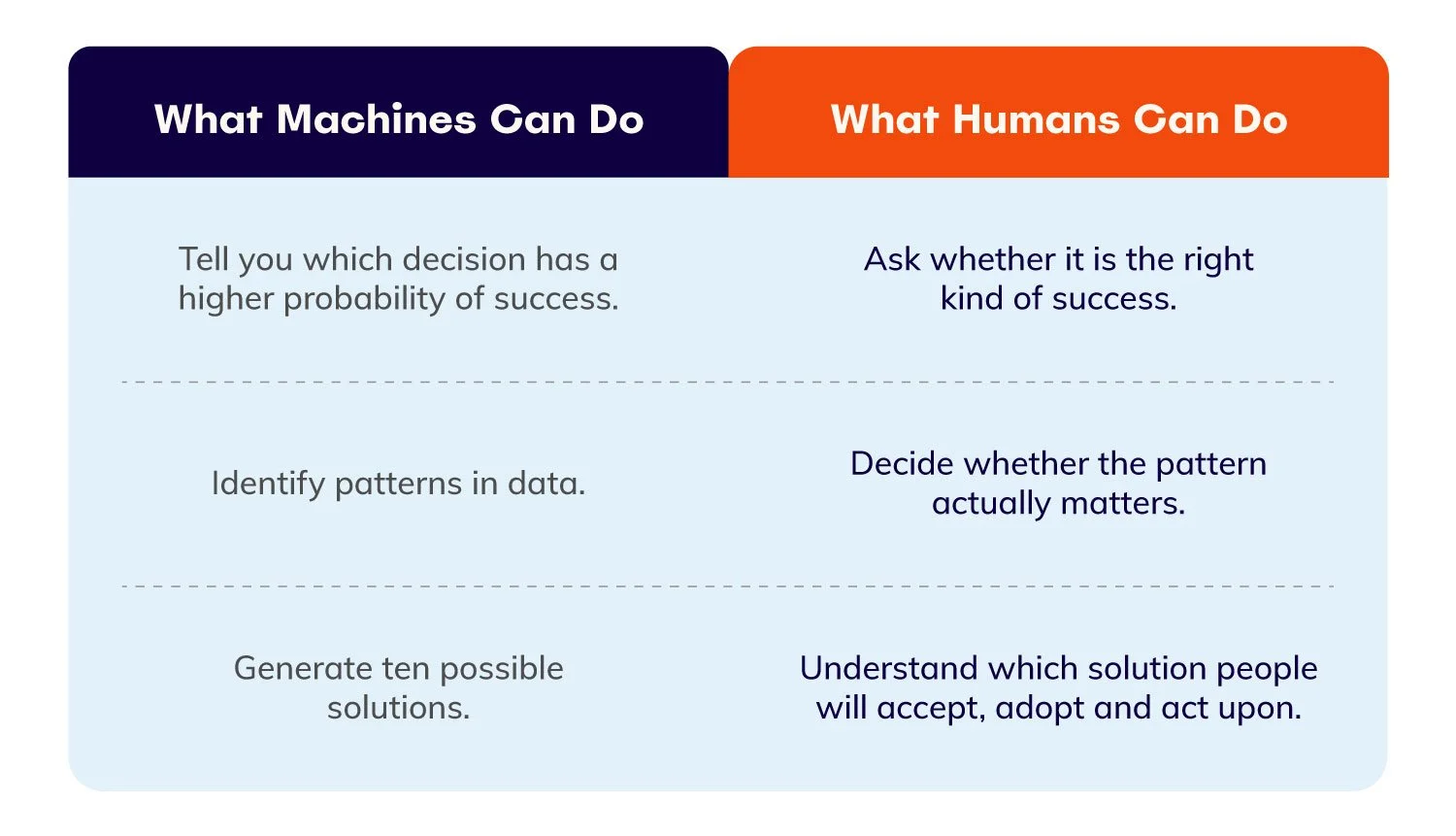
And suddenly, the "soft skills" don't look so soft.
For years, the workplace has had a slightly strange habit of dividing skills into "hard" and "soft". Data analysis was hard; so was coding, technical knowledge, and the like. Communication, empathy, collaboration and adaptability were placed rather politely in the softer category.
But in an AI-powered world, these capabilities are becoming increasingly important.
A teacher must know when an AI-generated lesson works and when it will not; a student must be able to distinguish credible information from misinformation; a leader must question an output when the consequences extend beyond what the data can explain.
This is the thought behind Maxme, a human skills development platform that helps individuals and teams build capabilities such as self-awareness, communication and collaboration. Its new programmes, AI for Educators and DigiSense, bring this philosophy into schools, addressing two important needs:
Helping teachers use AI effectively.
Assisting students in navigating the digital world responsibly.
Helping educators become AI-ready
AI’s revolution is not just restricted to the global workplaces, but it has also flipped how teachers teach in class, approach assessments, or even manage everyday academic responsibilities. But if you believe technology integration is all it takes to make things efficient, you might want to think again. Educators don't just need technical prowess but also need the confidence and practical skills to use it meaningfully.
Maxme’s AI for Educators is a 25-hour professional development programme designed for CBSE and CISCE schools. Let’s look at how this programme is changing the way curriculum is being taught and delivered inside Indian classrooms:
Delivered through a 4-day, school-based pathway. It covers AI tools and productivity, AI pedagogy and academic practice, school and teacher productivity, and the human side of AI.
The programme helps teachers explore practical applications of AI across classroom teaching, academic planning, assessment and school operations.
It also includes an AI Teachers Toolkit and completion credentials
The objective is clear: to help teachers use technology more effectively while retaining the judgement, empathy and understanding that good teaching demands.
Teaching students to think before they click
For students, the challenge extends beyond using AI; it includes questioning what they encounter online and making sense of it, and even believing what they have just read is true or false.
Maxme’s DigiSense, designed for students in Classes 7–12, centres on: think before you click.
Through a practical workshop, students learn to:
Question the accuracy and sources of online information.
Recognise misinformation and deepfakes.
Understand their digital footprint, and navigate issues such as cyberbullying, online behaviour and digital reputation.
In an era swamped with AI, where data generated looks convincing more often than not, it is skills like critical thinking and responsible communication that have become more important than ever. Being digitally capable is no longer enough; students must also learn to be digitally responsible.
The future needs both.
At Maxme, this is the idea at the heart of what we do. We know for a fact that technology will keep evolving and the tools we use today, perhaps would look very different or completely different from a few years from now, but we also know that humans who are behind using these tools must grow.
Through AI for Educators and DigiSense, Maxme is addressing both sides of this challenge: empowering teachers to integrate AI into education and equipping students to navigate the digital world with greater awareness and judgement.
By now, it’s quite clear that the future doesn't need humans to compete with machines at being machines; it needs humans who know how to use intelligent technology while bringing something uniquely their own to the table. AI will keep getting smarter, but we must ensure that human intelligence keeps getting better, too.
More human goodness you might like: